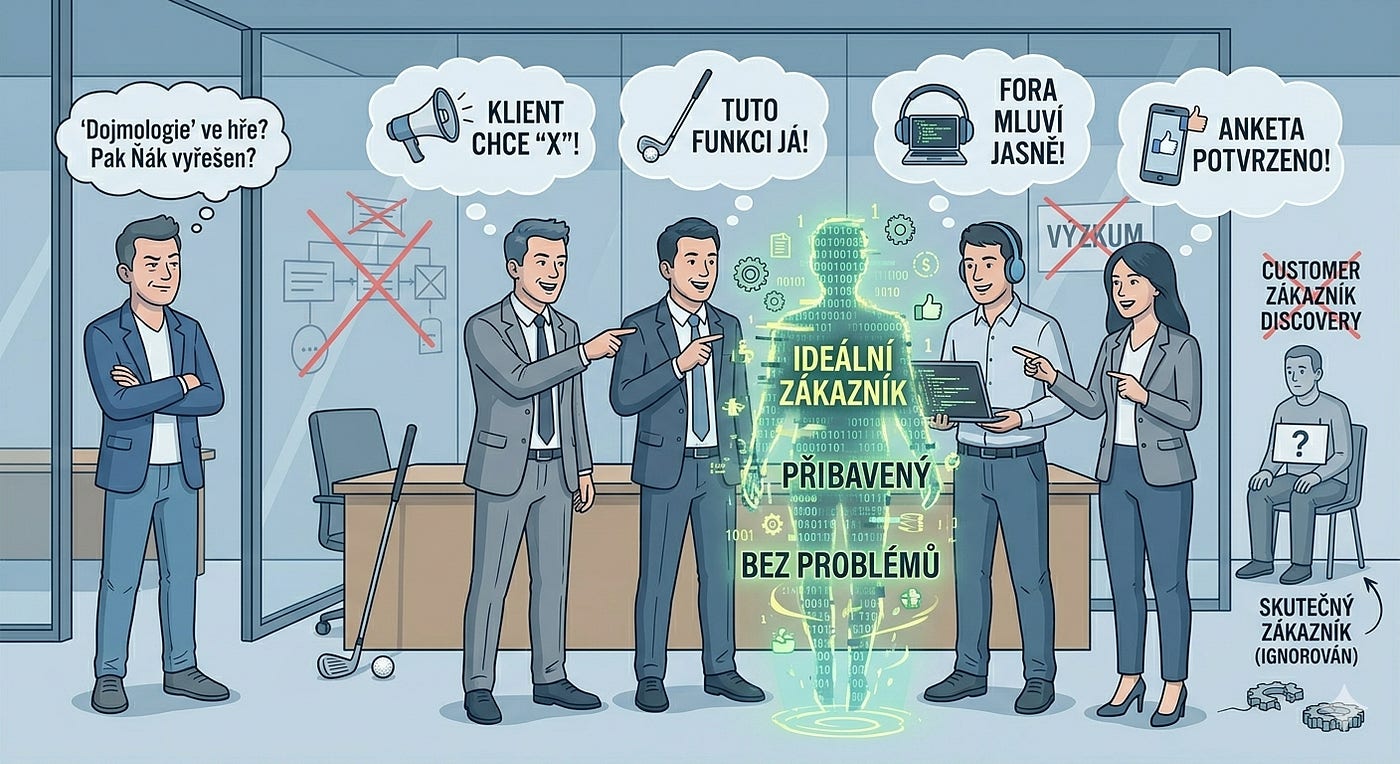
“We know what our customer wants”
Even though nobody asked them. Why companies build an imaginary customer instead of the real one – and how to run a customer conversation that tells you something.
 Václav Duda25 May 2026 · 3 min readVáclav Duda7 Apr 2026 · 5 min read
And why mixing up the two roles can cost more than you would expect.
Browse the Czech job boards for a product manager and you will notice something interesting. A company is hiring a product manager, but the job description is about assigning tasks, overseeing day-to-day operations and communicating with development. Or it is hiring a Product Owner, but expects them to design the go-to-market strategy and own the revenue.
This mix-up is not a harmless HR word game. It is one of the most common dead ends, and it leads to companies burning money, delivering late and frustrating their teams. The best are the ads where, whatever the job title, the requirements for this “product person” blend together. In short, they are looking for Superman. Or a product ninja.
Let’s clear this up, whether you build software or manufacture vacuum cleaners. I have done both, so I can compare – and there are more similarities than you would think. What follows applies to practically any industry, whatever the roles happen to be called.
In my view, one basic rule sums it up best:
The Product Manager (PM) looks outward – at the market, customers and the business: what should we do and why, for whom and which customer problem we are solving, and how we make money from it.
The Product Owner (PO) looks inward – at the delivery team and execution itself: how we will actually build it and when, and whether we have the capacity.
The Product Manager carries business responsibility. They are the Business Owner. They must know who the customer is, what problem we solve and how the company makes money from it. They build the portfolio, own pricing and work with sales. They provide the sales arguments, and the material and input for marketing communication.
The Product Owner, by contrast, is the delivery expert. They make sure the people actually building the product know exactly what to do and why. They manage the backlog, slice complex requirements into smaller, manageable pieces and make sure every phase of the work makes sense. They often hold deep technical or domain know-how.
In a discussion under one of my LinkedIn posts, people rightly pointed out that the Product Owner role is often degraded today. They are right. The word “owner” is often misleading in this context. If the PO decides nothing and just dutifully copies requests into Jira, they own nothing. They have become a water carrier.
And that is where the problem starts. Without a business-owner filter, anyone in the company with a bright idea can bring a request – whether it is the CEO with a brilliant idea because a business partner asked about it on the golf course at the weekend, or the loud salesperson whose customer wants it and who swears it is the one missing feature that will finally make the thing sell. The task is written up as a single sentence without context and thrown over the wall. The PO has to guess what the author meant, without understanding the context or why it should be done. And the team ends up building something nobody actually wanted. That is not a communication failure. It is a failure of structure and system.
The PO and PM must work as equal partners, not as random requesters and their assistant. Together they can better withstand pressure from outside and from within the team, and keep the product together.
The short answer: in a five-person startup, maybe. But once the product and the company grow, it is a road to hell. The two roles simply cannot be merged – mainly because one person physically cannot keep up.
You cannot realistically sit in strategy meetings, argue with sales about margins and handle marketing campaigns while also being available to the delivery team every day, answering operational questions and properly preparing detailed specifications for the next piece of work.
Ask someone to do it and one of those legs will start limping very quickly. Either they neglect the market and the strategy (so you build efficiently, but things nobody buys – or you lose your shirt), or they neglect the team (you have a great vision, but people stand around not knowing what to do, so you deliver nothing). Combining the roles reliably leads only to overload and burnout.
Beyond the work itself, the Product Owner and the Business Owner are completely different species. The PO is usually a technician, a methodologist, a former developer or electrical engineer – or simply a subject-matter expert. The Business Owner is more of a marketer in the true sense of the word: someone handling the complete marketing mix. (I wrote about what marketing actually is in “We’ll just do some marketing.”)
I confirmed long ago that this split makes sense outside IT too. At ETA, for example, we used exactly this model during the company’s transformation. My colleague, as the “technical product person” (the PO), ran the test lab, detailed technical specifications, manuals, real-world operation and sample testing. He worked with production and defined the technical requirements. He knew the product down to the last screw. Literally. I, as the business product person (the PM), looked after the portfolio, searched for gaps in the market, studied GfK market data, set prices for each sales channel, handled product communication and fought with sales.
Neither of us could have done the other’s job. Perhaps parts of it – but above all, we would not have had the capacity. Together we were able not only to design the product, but to actually launch it and sell it, because it targeted the right segment.
The key is not which acronym you print on the business card. It is understanding that a product’s strategic direction and its actual production are two different, if connected, disciplines.
If your company mixes them up, or expects one person to do both, do not be surprised when your products end up in a dead end.
Translated from the Czech original, first published on Václav Duda’s Substack Produktový management prakticky.
 Product & marketing
Even though nobody asked them. Why companies build an imaginary customer instead of the real one – and how to run a customer conversation that tells you something.
Václav Duda25 May 2026 · 3 min read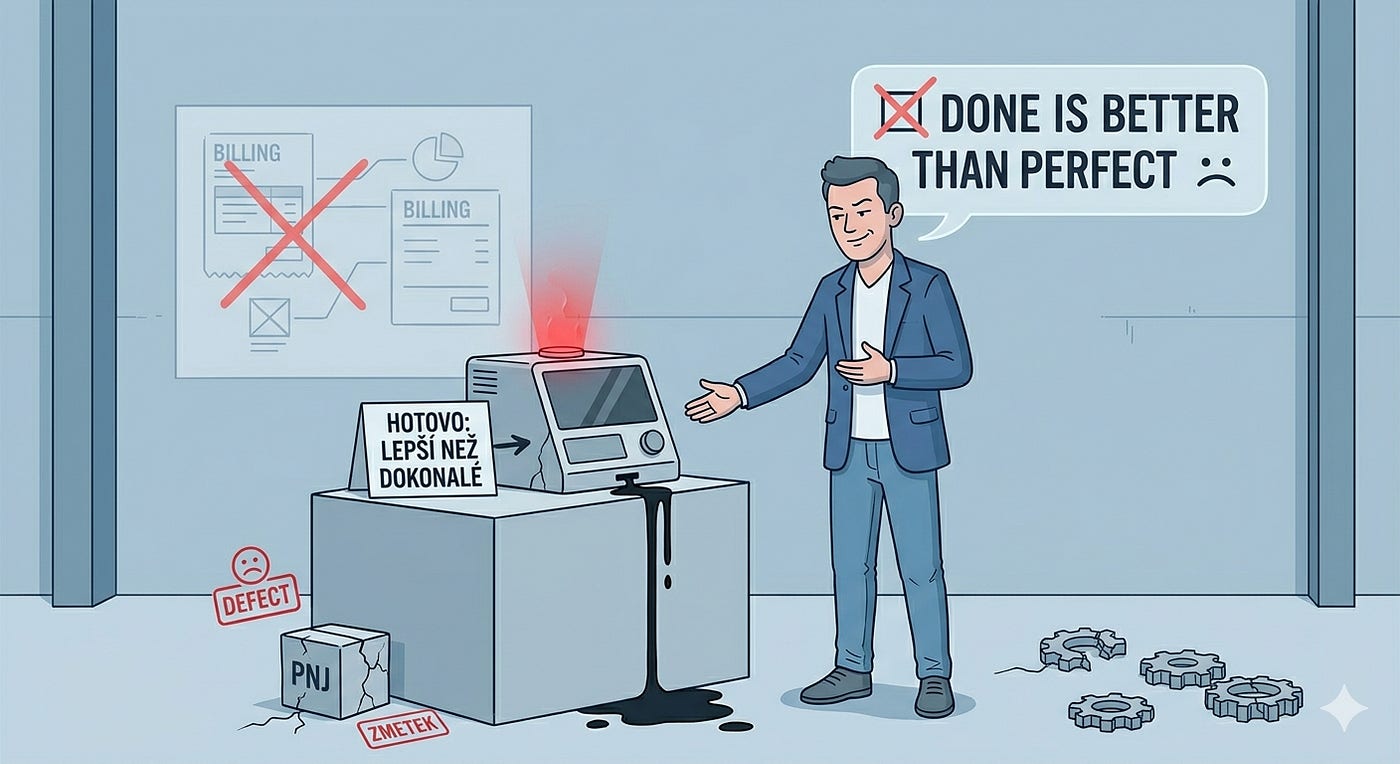 Product & marketing
The most important word has gone missing from MVP – “viable”. A real case where a half-baked SaaS launch came back to bite pricing, invoicing and the ERP.
Václav Duda17 Apr 2026 · 2 min readTell us what you are facing. We will get back to you within one business day.
Or directly: +420 773 996 588 · info@strategix.one